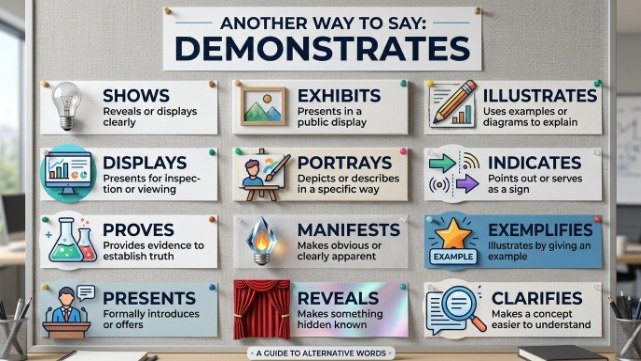
Words matter. The word “demonstrates” is common in essays, reports, emails, reviews, and daily speech. But using it again and again can make your writing feel dull.
Finding another way to say demonstrates can make your sentences clearer, stronger, and more natural. You may want a formal option for academic writing, a simple phrase for everyday conversation, or a creative expression for a personal message.
The best replacement depends on what you mean. Does something show, prove, highlight, reveal, or make clear an idea? Choosing the right phrase helps your reader understand your point without extra effort.
Below are useful alternatives to “demonstrates” for different situations.
Another Way to Say Demonstrates in Formal and Professional Writing
In business, academic, and professional writing, you often need words that sound clear and polished. Instead of repeating “demonstrates“, choose an alternative that matches the exact meaning of your sentence.
Here are useful options:
- Shows
- Clearly shows
- Clearly indicates
- Indicates
- Reveals
- Highlights
- Illustrates
- Displays
- Presents
- Establishes
- Proves
- Confirms
- Supports
- Provides evidence of
- Offers evidence of
- Makes clear
- Points to
- Reflects
- Signals
- Suggests
- Expresses
- Communicates
- Conveys
- Emphasizes
- Underlines
- Reinforces
- Validates
- Documents
- Represents
- Exemplifies
Examples in professional writing
- The report shows a steady rise in customer demand.
- The data clearly indicates strong market growth.
- The study reveals a link between sleep and productivity.
- The results highlight the need for better training.
- The project illustrates the value of teamwork.
- The chart displays changes in sales over time.
- The evidence supports the main argument.
- The findings provide evidence of improved performance.
- The results confirm our original prediction.
- The survey reflects changing customer preferences.
- The report points to several areas for improvement.
- The research suggests that the method is effective.
- The figures establish a clear pattern.
- The experiment proves the effectiveness of the treatment.
- The presentation communicates the main goals clearly.
- The example illustrates how the process works.
- The results reinforce the importance of planning.
- The findings validate the proposed approach.
- The report emphasizes the importance of customer service.
- The evidence makes clear that action is needed.
- The case study exemplifies successful leadership.
- The graph reflects the companys recent growth.
- The results signal a major change in consumer behavior.
- The analysis underlines the need for careful planning.
The key is to choose a word based on your meaning. Shows is broad and simple, while proves is much stronger. If the evidence only suggests something, suggests may be a better choice.
Another Way to Say Demonstrates in Academic and Educational Writing
Academic writing often uses “demonstrates” to explain what research, evidence, examples, or results reveal. However, repeating the same word can make an essay sound mechanical.
These alternatives work well in essays, research papers, assignments, and presentations:
- Shows
- Illustrates
- Indicates
- Reveals
- Establishes
- Suggests
- Supports
- Confirms
- Highlights
- Explains
- Clarifies
- Proves
- Reflects
- Represents
- Provides evidence
- Gives insight into
- Makes evident
- Makes clear
- Points toward
- Draws attention to
- Reinforces
- Strengthens
- Exemplifies
- Displays
- Emphasizes
Examples for essays and research
- This example shows why communication is important.
- The research indicates that exercise improves mood.
- The experiment reveals an important trend.
- The results suggest that the theory may be correct.
- The evidence supports the researchers argument.
- The findings confirm the original hypothesis.
- The case study illustrates the impact of social media.
- The statistics highlight a major concern.
- The study establishes a strong connection between the two factors.
- The example clarifies the central idea.
- The evidence provides insight into student behavior.
- The results make evident the need for further research.
- The findings make clear how the process works.
- The data points toward a possible solution.
- The discussion draws attention to an important issue.
- The example reinforces the main argument.
- The research strengthens the claim.
- The experiment exemplifies the scientific method.
- The graph displays the change over time.
- The evidence emphasizes the importance of education.
- The results reflect broader social changes.
- The findings provide evidence that the method works.
- The example represents a common problem.
- The study explains why certain results occurred.
Which academic alternative should you use?
Use illustrates when you explain an idea through an example.
Use indicates when evidence points toward a conclusion.
Use suggests when the evidence is not strong enough to make a definite claim.
Use proves only when the evidence truly establishes something beyond reasonable doubt.
Use supports when evidence helps strengthen an argument.
This small difference can make academic writing more accurate.
Another Way to Say Demonstrates in a Friendly, Creative, or Emotional Way
Sometimes “demonstrates” sounds too formal. If you are writing a message, social post, personal story, review, or emotional statement, you may want something warmer and more natural.
Try these creative alternatives:
- Shows
- Makes it clear
- Says a lot about
- Speaks volumes about
- Tells us
- Brings out
- Brings to light
- Makes visible
- Puts on display
- Lets us see
- Gives us a glimpse of
- Proves just how
- Shows just how
- Makes obvious
- Brings attention to
- Shines a light on
- Paints a picture of
- Tells the story of
- Reflects
- Captures
- Reveals
- Expresses
- Shows the true side of
- Gives a clear picture of
- Shows what really matters
Creative examples
- Her smile shows how happy she feels.
- His actions speak volumes about his character.
- The small gesture says a lot about their friendship.
- Her kindness reveals the person she truly is.
- The photo captures the joy of the moment.
- His effort shows just how much he cares.
- The story brings to light a hidden problem.
- Her words express her deepest feelings.
- The simple gift makes it clear that he remembered.
- Their teamwork shows what really matters.
- The painting gives us a glimpse of the artists imagination.
- His actions tell the story of his dedication.
- The result paints a picture of a changing world.
- Her response reflects her confidence.
- The moment brings out the best in everyone.
- His support shows the true side of friendship.
- The scene shines a light on an important issue.
- Their success proves just how powerful teamwork can be.
- Her words make obvious how deeply she cares.
- The experience gives a clear picture of the challenges ahead.
- His patience shows the strength of his character.
- The celebration captures the spirit of the community.
- Their actions tell us what they value most.
- The final result brings attention to the importance of preparation.
These options are useful when you want your writing to feel more human. They work especially well when talking about people, emotions, relationships, or meaningful moments.
Short Alternatives to Demonstrates for Quick Responses
Sometimes you do not need a long phrase. A short replacement can make your sentence cleaner and easier to read.
Here are quick options:
- Shows
- Indicates
- Reveals
- Proves
- Highlights
- Illustrates
- Reflects
- Confirms
- Supports
- Suggests
- Displays
- Explains
- Clarifies
- Signals
- Establishes
- Expresses
- Presents
- Represents
- Emphasizes
- Reinforces
- Validates
- Exemplifies
- Conveys
- Documents
- Identifies
Quick sentence swaps
- The data demonstrates growth. → The data shows growth.
- The study demonstrates a connection. → The study indicates a connection.
- Her actions demonstrate kindness. → Her actions reflect kindness.
- The example demonstrates the process. → The example illustrates the process.
- The results demonstrate success. → The results confirm success.
- His work demonstrates skill. → His work shows skill.
- The chart demonstrates the trend. → The chart highlights the trend.
- The evidence demonstrates the claim. → The evidence supports the claim.
- The experiment demonstrates the theory. → The experiment illustrates the theory.
- Her response demonstrates confidence. → Her response shows confidence.
- The findings demonstrate improvement. → The findings reveal improvement.
- The example demonstrates the problem. → The example clarifies the problem.
For most everyday situations, shows is the easiest and safest replacement. It sounds natural without making the sentence complicated.
Tips for Choosing Another Way to Say Demonstrates
Choosing the right synonym is not only about finding a different word. You should also think about meaning, tone, and strength.
1. Use shows for simple writing
Shows is clear, natural, and easy to understand.
Instead of:
The report demonstrates an increase in sales.
You can write:
The report shows an increase in sales.
This is often better for simple online content and everyday communication.
2. Use indicates for evidence
Choose indicates when something points toward a conclusion without completely proving it.
For example:
The data indicates a change in customer behavior.
This sounds careful and professional.
3. Use illustrates for examples
Use illustrates when an example helps explain an idea.
For example:
This story illustrates the importance of patience.
It works especially well in essays and educational content.
4. Use proves only for strong evidence
Proves is stronger than demonstrates. Do not use it when the evidence is weak or uncertain.
For example:
The experiment proves that the machine works under these conditions.
If the evidence only points toward that conclusion, shows, indicates, or suggests may be better.
5. Match the word to your audience
Think about who will read your sentence.
For a child or general reader, use shows.
For a business report, use indicates, highlights, or reveals.
For academic writing, use illustrates, supports, establishes, or suggests.
For emotional writing, try speaks volumes about, reflects, or captures.
Conclusion
Finding another way to say demonstrates can make your writing more natural, precise, and engaging. The best alternative depends on what you want to communicate.
For simple sentences, shows is often the best choice. For evidence, try indicates, supports, or confirms. When explaining an example, illustrates works well. For stronger claims, establishes or proves may fit. In personal or creative writing, phrases such as speaks volumes about, reflects, and captures can add warmth.
Do not replace “demonstrates” just for the sake of using a different word. Choose the phrase that gives your sentence the exact meaning you want.

Oscar Wilde is a passionate writer with 7 years of experience, specializing in English grammar and effective replies. At respnseto.com, he shares practical tips, insights, and engaging content to help readers communicate clearly and confidently. His work blends expertise with a friendly, approachable style for all audiences.